Office chairs are sold on features: lumbar systems, 4D arms, recline locks. Whether a chair fits you is decided earlier, by two plain numbers on the spec sheet. Seat height range has to reach the height of the crease behind your knee, so your feet rest flat and your thighs are level. Seat depth has to support most of your thigh without the front edge pressing into the back of your knee. Get those right and the rest is adjustment; get them wrong and no feature compensates.
This guide shows how to take the two measurements that map to those ranges, then gives lookup tables against the published ranges of chairs we cover. The chair figures come from each manufacturer's specification guide or product page, and the measuring method follows the general principles in OSHA's workstation guidance. Body proportions vary widely, so measure yourself rather than relying on height alone.
How we research. We compare published specifications, manufacturer documentation and the details on each listing. We have not tested these products ourselves. Prices come from Amazon and were checked on the date above; they change often. As an Amazon Associate we earn from qualifying purchases, at no extra cost to you. Our method · Disclosure
Quick answer
The two numbers that matter
Anthropometry, the measurement of bodies, has names for both. Popliteal height is the distance from the floor to the underside of your thigh just behind the knee, with your feet flat and your knee bent at about a right angle. It sets the seat height you need. Buttock-to-popliteal length is the distance from the back of your buttocks to the back of your knee, sitting upright. It sets the seat depth you need.
You will also see buttock-to-knee length, measured to the front of the kneecap. It is easier to measure but includes the knee itself, so it overstates the seat depth you need; if that is the number you have, subtract the thickness of your knee. Height alone is a poor guide to either measurement, because people of the same height can have long legs and a short torso or the reverse.
How to measure yourself
You need a tape measure, a firm flat chair or stool, a hardback book and the shoes you usually work in. A second person makes it easier but is not essential.
Sit on a firm, flat seat
Use a kitchen chair, stool or bench without a cushion, low enough that your feet rest flat with your knees bent at roughly 90 degrees. Wear your usual work shoes (or go barefoot if that is how you work); shoes typically add an inch or so.
Measure popliteal height
Measure straight down from the underside of your thigh, right at the crease behind your knee, to the floor. If the chair you are sitting on is too high, put books under your feet until your thighs are level and add their height. This is your target seat height.
Measure thigh length
Sit upright with your back and buttocks against a wall (or a door edge). Slide a hardback book along your thigh until its spine touches the back of your knee, then measure from the wall to the book. This is your buttock-to-popliteal length.
Measure seated hip width
Sitting, measure across the widest part of your hips. Add an inch or two each side for room: that is the minimum seat width and space between the arms you want.
Note your seated elbow height
With shoulders relaxed and elbows at your sides, measure from the floor to the underside of your forearm. Your desk or keyboard surface should sit close to this once the chair is set; our standing desk height guide covers the desk side.
How the measurements map to a chair
Seat height: set the seat at your popliteal height or slightly below. OSHA's guidance describes the right height as the whole sole of the foot on the floor with the back of the knee slightly higher than the seat. A seat that is too high leaves your feet unsupported and pushes you forward off the backrest; too low and your thighs lift off the seat, loading your tailbone. So the chair's range needs to reach your number, and ideally go an inch below it.
Seat depth: with your back against the backrest, the front edge of the seat should stop short of the back of your knee. OSHA describes it as supporting most of the thigh without contact behind the knee; a common rule of thumb is a gap of about 2–3 in, or two to four finger widths. So your target seat depth is roughly your buttock-to-popliteal length minus 2–3 in.
One caution on comparing chairs: brands measure seat depth differently. Steelcase publishes 'functional' depth (the usable cushion from backrest to front edge at each end of its travel), which is the most useful figure. Other brands may quote the seat pan's overall length, which reads deeper. Compare numbers from the same brand where you can, and treat a single cross-brand difference of an inch with care.
Seat height lookup
Find your popliteal height (in shoes) and see which chairs' standard seat height range reaches it. Ranges from each manufacturer's specification guide or product page.
| Your popliteal height | Set the seat to about | Chairs whose standard range covers it |
|---|---|---|
| 15 in or less | 14.5–15 in | None on standard cylinders; use a footrest, a low-range cylinder (Steelcase lists them for Series 1, Series 2, Gesture and Karman) or a Herman Miller Aeron Size A (14.75–19 in) |
| 16 in | 15.5–16 in | Steelcase Leap (15.5–20.5 in), Steelcase Karman (15.8–20.4 in), Steelcase Gesture (16–21 in) |
| 17 in | 16.5–17 in | Leap, Karman, Gesture, Steelcase Series 1 and Series 2 (16.5–21.5 in), Haworth Fern (16.5–21.5 in), Branch Ergonomic Chair (17–21 in) |
| 18–20 in | 17.5–20 in | All of the above; Secretlab Titan Evo XL from about 18.1 in |
| 21 in | 20.5–21 in | Gesture, Series 1, Series 2, Fern, Branch Ergonomic Chair, Titan Evo XL (to about 21.9 in) |
| 22 in or more | 21.5 in and up | Only the Titan Evo XL comes close on a standard cylinder; Steelcase lists taller cylinders (Leap 17–24 in, Gesture 17–22.5 in, Series 2 17.25–22 in) through dealers |
Secretlab quotes floor to seat base; Steelcase and Haworth quote floor to top of seat. Taller and lower cylinders are manufacturer options and are not what the Amazon listings ship with.
Seat depth lookup
Subtract 2–3 in from your buttock-to-popliteal length to get a target depth, then find chairs whose range includes it.
| Your buttock-to-popliteal length | Target seat depth | Chairs whose range includes it |
|---|---|---|
| 16–17 in | About 14 in | Steelcase Series 2 (14–17.75 in) |
| 18 in | 15–16 in | Series 2, Steelcase Series 1 (15.5–18 in), Haworth Fern (15.5–18.5 in), Steelcase Leap (15.75–18.75 in), Steelcase Gesture (15.75–18.5 in) |
| 19 in | 16–17 in | All of the above, plus SIHOO Doro C300 Pro V2 (16.9–18.5 in) |
| 20 in | 17–18 in | All adjustable seats above; fixed seats of Steelcase Karman (17.25 in) and SIHOO Doro C300 (18.1 in) |
| 21 in | 18–19 in | Leap (to 18.75 in), Fern, Gesture and SIHOO C300 Pro V2 (to 18.5 in), Series 1 (to 18 in), SIHOO Doro C300 (18.1 in) |
| 22 in or more | 19 in and up | Secretlab Titan Evo XL (fixed 19.7 in); adjustable office seats here top out below this |
Steelcase figures are functional depth. SIHOO, Haworth and Secretlab publish their own seat depth figures, which may be measured differently.
Chairs that fit specific measurements
One chair for each end of the range and one for the middle. For full rankings, see the roundups linked below.

Steelcase Leap
$1,124.25 · sold by Pattern. · Amazon shows a reference price of $1,398.91
The Leap has the lowest standard seat of the Amazon-stocked chairs we compared (15.5 in) and a depth range that starts at 15.75 in, so it suits popliteal heights from about 16 in and shorter thighs. It also reaches 18.75 in deep, so it adapts if someone taller shares it.
- Natural Glide System: the seat slides forward as you recline
- LiveBack backrest with lower-back firmness dial
- 3 in of seat depth travel per Steelcase
- Height-, width-, depth- and pivot-adjustable arms
- 12-year Steelcase limited lifetime warranty
- Your popliteal height is 16–20 in
- Your buttock-to-popliteal length is 18–21 in
- Your popliteal height is above 20.5 in
In stock on Amazon

Steelcase Series 1
$494.10 · sold by Pattern.
Series 1's 16.5–21.5 in seat and 15.5–18 in depth cover the middle of the range comfortably, with a 400 lb rating and 12-year warranty at the lowest Steelcase price.
- Weight-activated recline (no tension knob to set)
- 3D Microknit flexible back
- 2.5 in of seat depth travel per Steelcase
- Tool-free assembly per the listing
- 12-year Steelcase limited lifetime warranty
- Your popliteal height is 17–21 in and thigh length 18–20 in
- Your thighs are long; the depth tops out at 18 in
Only 3 left in stock - order soon.
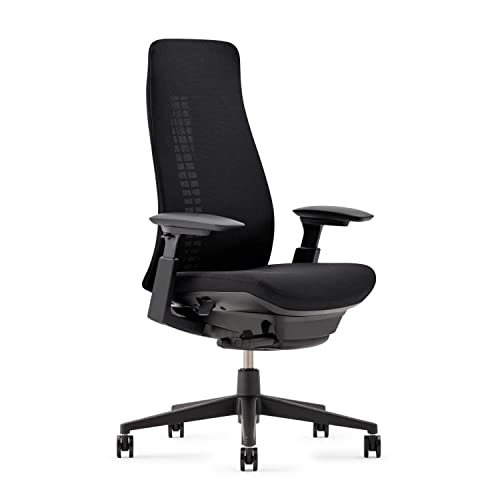
Haworth Fern
$998 · sold by Haworth Inc. · Amazon shows a reference price of $1,330
The Fern pairs one of the highest standard seats (16.5–21.5 in) with a seat that extends to 18.5 in, covering both long legs and long thighs better than most office chairs.
- Wave Suspension back that flexes as you move
- Adjustable lumbar and 4D arms on this listing
- 3 in of seat depth travel per Haworth
- Ships fully assembled per the listing
- 12-year warranty per Haworth
- Your popliteal height is 18–21.5 in and thigh length 19–21 in
- Your popliteal height is under about 17 in
In stock on Amazon

Secretlab Titan Evo XL
$729 · sold by Secretlab US
For popliteal heights above 21 in and thigh lengths of 22 in or more, the Titan Evo XL's seat (to about 21.9 in high, 19.7 in deep) goes further than any standard office chair here. Secretlab recommends it for 5 ft 11 in to 6 ft 9 in.
- Largest of three Titan Evo sizes
- Built-in four-way lumbar adjustment
- Heavy-duty gas lift and larger wheelbase on XL per Secretlab
- Cold-cure foam seat, leatherette on this listing
- Recline up to 165 degrees per Secretlab
- Standard chairs leave your knees above your hips
- Your thighs are short for your height; the seat depth is fixed
In stock on Amazon
Where to go next
With your two numbers in hand, the roundups become much quicker to read: every card shows the seat height and seat depth range, so you can rule chairs in or out at a glance. Start with our best ergonomic office chairs for the full range, or go straight to chairs for tall people or chairs for heavier bodies if you are at either end. If your budget is firm, our chairs under $500 applies the same fit checks at a lower price.
Common questions
How do I measure for an office chair?
Take two measurements sitting on a firm, flat seat in your work shoes: popliteal height (floor to the crease behind your knee, thighs level), which sets seat height, and buttock-to-popliteal length (back of buttocks to back of knee), which sets seat depth. Then pick a chair whose seat height range reaches your popliteal height and whose depth range includes that length minus 2–3 in.
What seat height do I need for my height?
Height is only a rough guide, because leg length varies so much between people of the same height. Measure your popliteal height instead and set the seat at or slightly below it. Most standard office chairs adjust between about 16 and 21.5 in.
How much space should there be between the seat and the back of my knees?
Enough that the seat edge does not touch the back of your knee when your back is against the backrest. A common rule of thumb is 2–3 in, about two to four finger widths.
What if my feet do not reach the floor?
Lower the seat first. If lowering it would put the desk too high for your arms, keep the seat where your arms need it and add a footrest so your feet are supported and your thighs stay level. OSHA's workstation guidance suggests the same.
Does seat depth matter if the chair has lumbar support?
Yes. If the seat is too deep, you cannot sit back far enough to reach the lumbar support at all; if it is too shallow, your thighs are unsupported. Seat depth decides whether the backrest can do its job.
Sources
- OSHA Computer Workstations eTool: chairs
- Steelcase Leap specification guide (2020)
- Steelcase retail portfolio specification guide (Leap and Gesture dimensions, cylinder options)
- Steelcase Series 1 specification guide
- Steelcase Series 2 specification guide
- Steelcase Karman specification guide
- Haworth Fern product page and dimensions
- Secretlab Titan Evo technical specification
- Herman Miller Aeron sizes
- Steelcase Leap: published specifications (steelcase.com)
- Steelcase Series 1: published specifications (steelcase.com)
- Secretlab Titan Evo XL: published specifications (blog.secretlab.co)
Specifications are taken from each manufacturer or listing, not from our own testing. Where a number is marked “Not published”, we could not confirm it from the manufacturer. Recommended viewing distances are calculated, as explained in how we research.